
Bringing Iron Maiden’s legendary track “Wasted Years” into the AI era was more than a fan project, it was a personal experiment in blending nostalgia with cutting-edge generative tools. Using ComfyUI, Flux Diffusion, and WAN 2.1, I set out to recreate the 1986 music video, frame by frame, breathing new life into Eddie with modern tech.
Some projects are more than just technical achievements they’re deeply personal. Wasted Years, my latest AI-generated music video, is exactly that. It’s a tribute not only to Iron Maiden’s legendary sound and sci-fi aesthetic but also to the passage of time itself.
As a lifelong fan, the idea of animating Eddie, the band’s iconic time-traveling mascot was the kind of childhood dream that stuck with me into adulthood. Everyone who grew up flipping through Maiden vinyl sleeves has probably asked themselves, “What would it look like if Eddie came to life?”, this video was my answer.
The message behind the song hit especially hard. Time is the only thing we can’t get back. After years spent chasing gigs, projects, and deadlines, Wasted Years became a reminder to live each one to its fullest.
Bringing Eddie to life, from restoring the original artwork to animating his transformation was pure joy every step of the way. This wasn’t just a fan edit. It was a passion project born from nostalgia and powered by modern AI tools.
I didn’t just want to make visuals for the track. I wanted to show what’s possible when classic heavy metal art collides with today’s creative workflows using ComfyUI, WAN 2.1, and Flux Kontext.
In this post, I’ll walk through the tools, process, and thought behind every frame. From removing legacy typography and upscaling album art, to animating Eddie with AI and turning 4:3 cover art into cinematic widescreen shots, this project was made for artists, fans, and technologists alike.
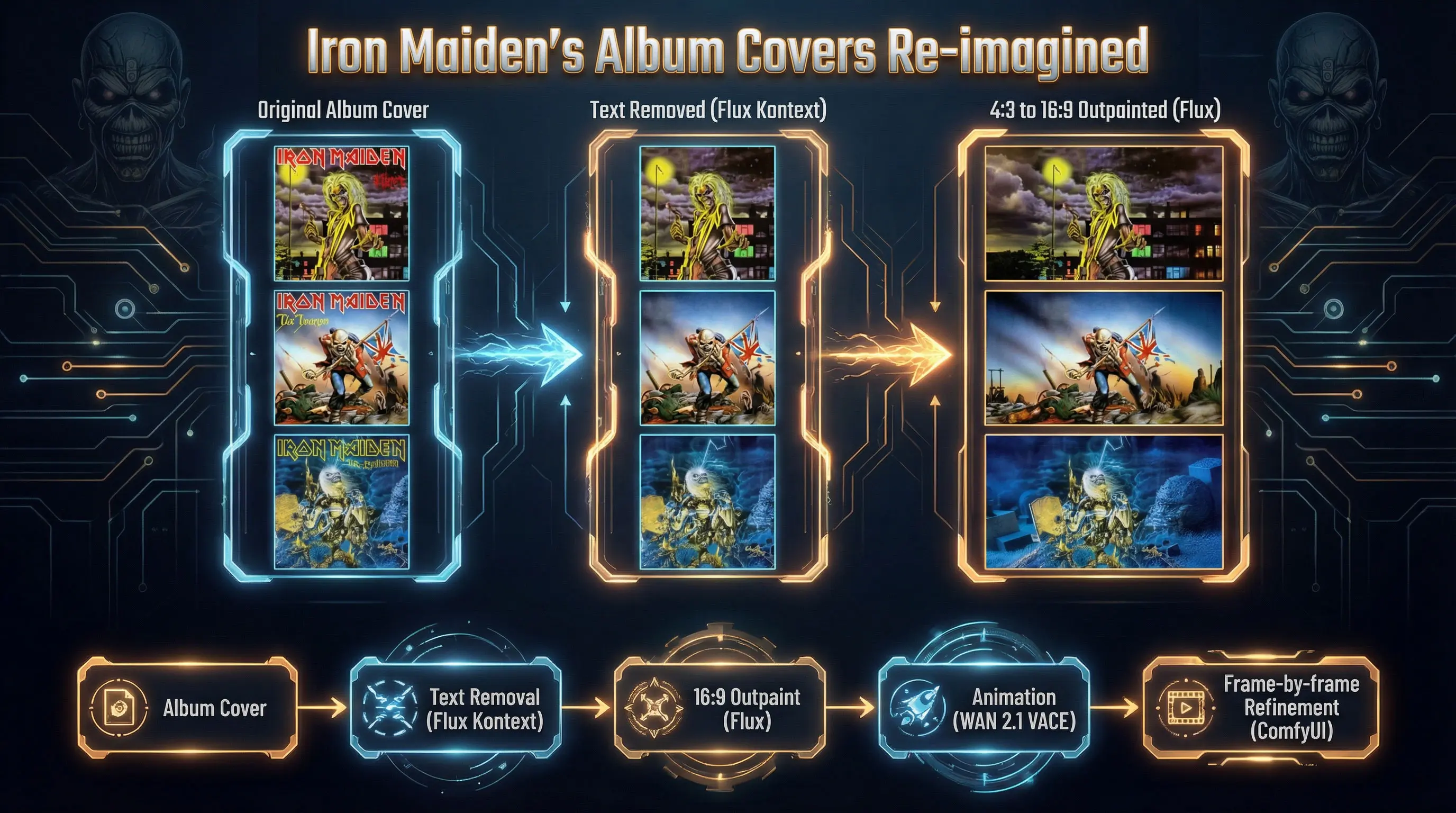
The first step was to eliminate the legacy typography titles, band logos, and other graphic overlays while preserving the integrity of the original artwork. For this, I used Flux Kontext, one of the earliest instruction-based AI editing diffusion models. By prompting it with simple tasks (like “remove text” or “clean upper area”), I was able to generate clean, unobstructed versions of the artwork. This gave me a blank canvas for creative expansion.
This step is crucial for any artist or designer looking to repurpose classic 4:3 artworks for modern formats. Clean removal ensures that later stages of outpainting and animation feel seamless and professional. We have newer tools at our disposal to do this such as Qwen Edit, Googles Nano Banana and SeedDream now that yield better results.
With the clean versions in hand, the next challenge was out-painting, essentially expanding the edges of the image to fit a 16:9 widescreen frame while maintaining stylistic consistency.
I turned to WAN 2.1 and VACE-to-Video tools, which helped with the out-painting.
The result: fully reimagined album covers that feel like they were meant to be seen in widescreen.
The out-painting process wasn’t just about filling space—it was about imagining what the original artists might have created had they been working for a cinematic format. Every added detail, from clouds to neon-lit buildings, was generated with intention and tuned to match Iron Maiden’s dark, dystopian aesthetic.
As an artist, I hold deep respect for the legacy of Derek Riggs, the original illustrator behind these Iron Maiden covers. His work shaped the visual identity of an entire generation of metal fans. This project was never about replacing or overshadowing his art but rather honoring it by exploring what these covers might look like through the lens of modern tools and widescreen storytelling.
***special note due to copyright issues this song cant be played outside of the US so if your having issues please try this link or use a VPN
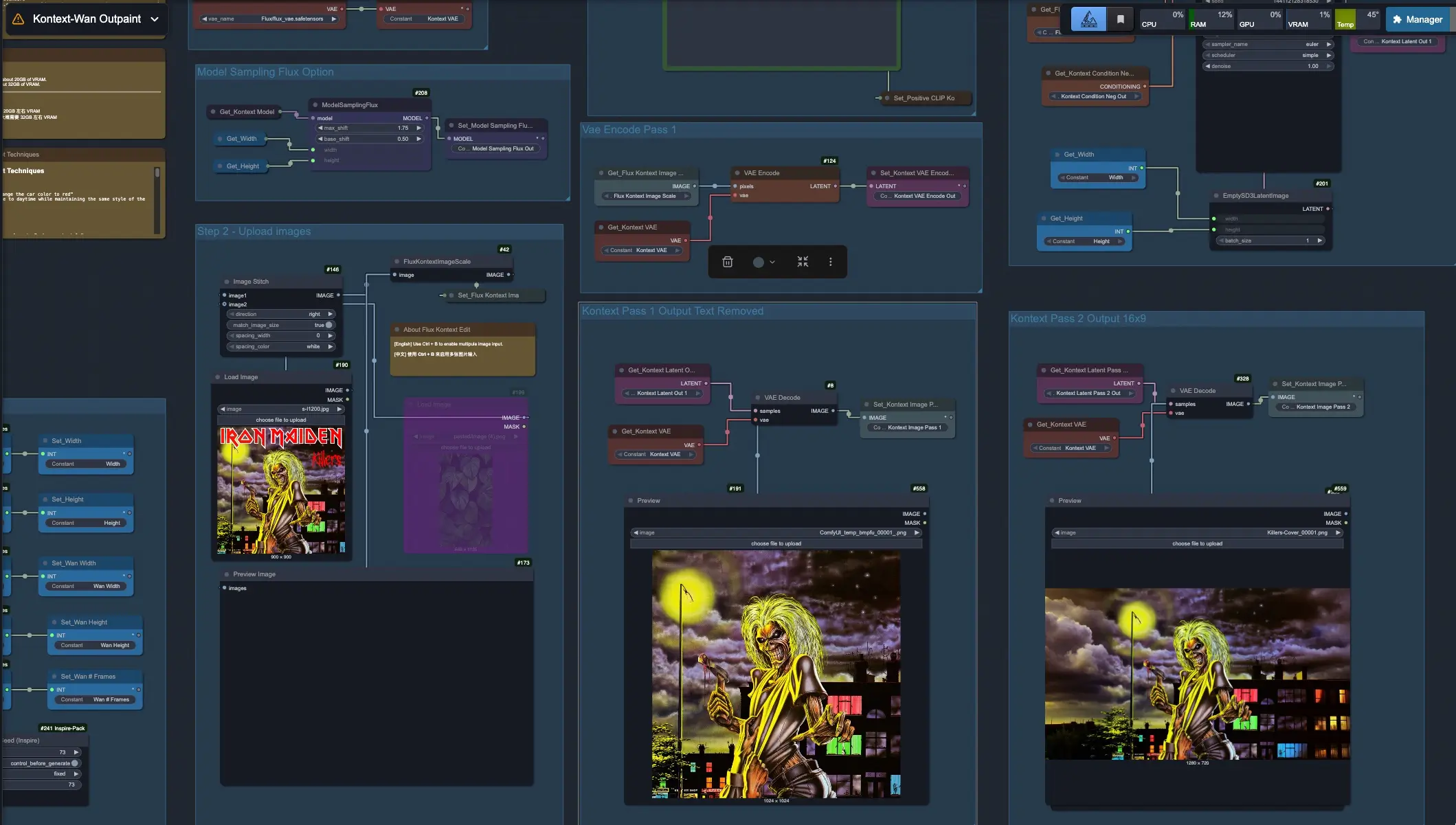
After achieving clean, widescreen versions of the album covers, the next challenge was breathing life into Eddie himself. Using ComfyUI, I built a series of custom workflows designed specifically to animate these newly expanded frames. This wasn’t a plug-and-play solution, it required a deep understanding of node-based workflows construction, diffusion models, and iterative testing.
To handle the animation process, I used the WAN 2.1 VACE system, a powerful image-to-video diffusion model. VACE excels at turning a single image into a dynamic video clip, capable of expanding context, generating realistic motion, and retaining style coherence across frames. I input the 16:9 out-painted artworks and guided the system using highly specific prompts to control both animation style and character movement. I also ran some of them though some custom Wan 2.1 Image to Video workflows as well. It’s always best to test various methods to see which on works better for you and what your needs are.
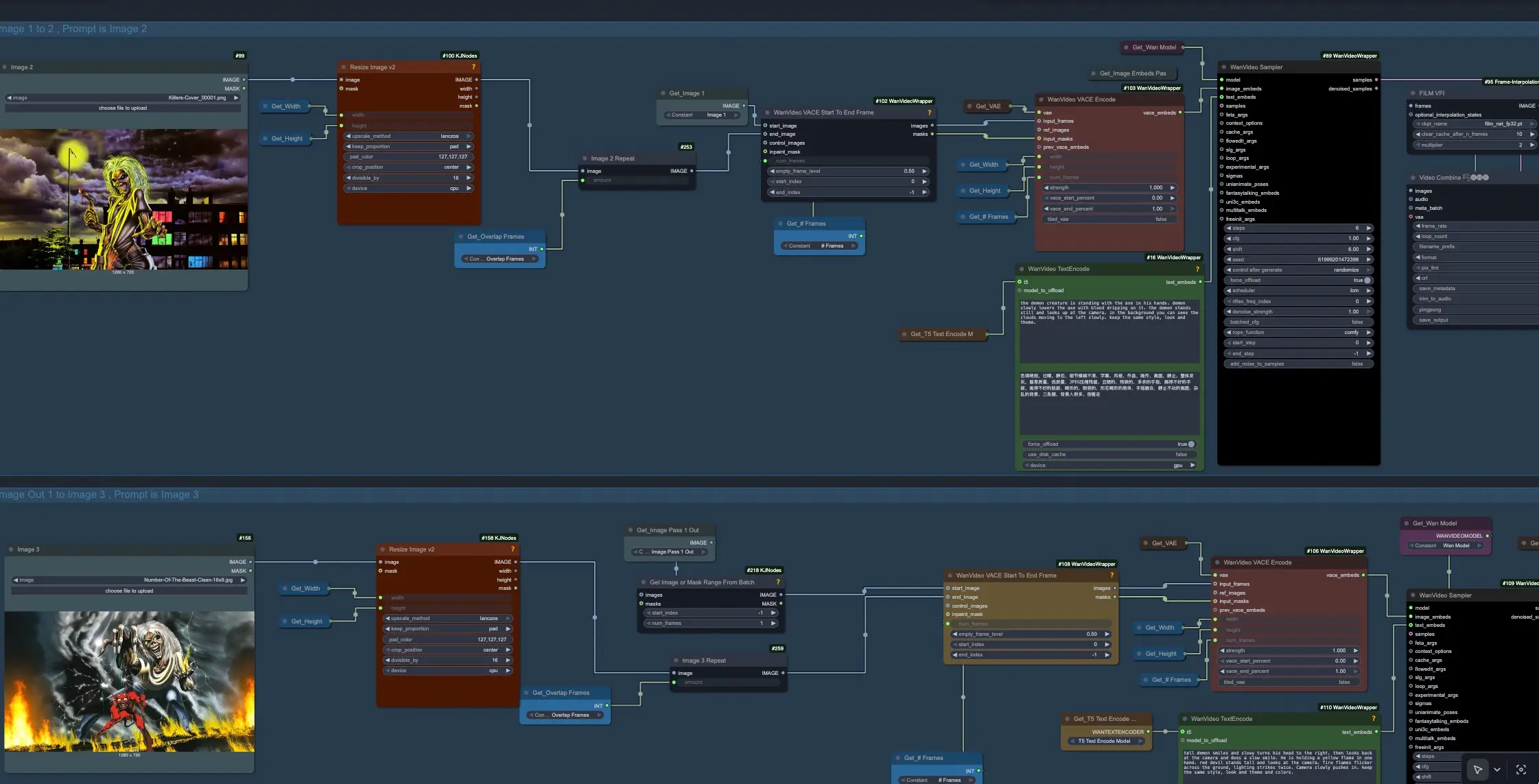
It’s easy for some to assume that creating visuals like this is as simple as “typing a prompt.” The truth is far from it. For each animated sequence, I went through dozens of iterations testing prompt phrasing, tweaking keyframes, adjusting CFG, steps, seed values, motion Loras, and managing output resolution and stability. Many early attempts failed outright, or produced uncanny results that broke the style.
What made this work wasn’t just access to powerful tools, but a commitment to craft. Each frame is the result of painstaking iteration, visual intuition, and creative troubleshooting, not automation.
By combining ComfyUI’s modular control with WAN 2.1’s animation capabilities and Flux Kontext’s consistency in out-painted frames, I was able to bridge the gap between static album art and immersive visual storytelling. Eddie didn’t just move he came alive in the same spirit that defined Iron Maiden’s legendary aesthetic.
This project took over a month of focused work. Not because I had to, but because I wanted to. “Wasted Years Reimagined” is a five-minute video, but behind every second are hundreds of hours of iteration, experimentation, and refinement. Using a custom ComfyUI workflow I built from the ground up, I leveraged tools like WAN 2.1 VACE to out-paint and animate Iron Maiden’s most iconic imagery, effectively bringing Eddie to life in motion. This took countless failed attempts, manual tweaks, and artistic judgment calls to achieve something that felt right.
This wasn’t about chasing clicks, going viral, or monetizing nostalgia. It was about fulfilling a dream I’ve carried since childhood. I grew up obsessed with Iron Maiden’s album covers, posters, and lore. As a creative professional with 25+ years in visual storytelling, I finally had the tools to do what I only imagined back then: step inside the world of Somewhere in Time, Seventh Son, Live After Death, and more and make them move.
I carefully overlaid these sequences on top of the original “Wasted Years” music video, not to overwrite it, but to elevate it, to create something immersive, personal, and timeless. The music, the visuals, the soul of the band, they all matter.
Iron Maiden isn’t just a band, they’re a cultural force. Bruce Dickinson’s vocals. Steve Harris’ songwriting. The sonic power that shaped the soundtrack of so many lives, mine included. This project stands as a tribute to the band that inspired me to think big, to imagine other worlds, and to push creative boundaries.
Thank you, Iron Maiden, for the music. For the energy. For the legacy.
None of this would have been possible without the brilliance of Derek Riggs, the mastermind behind Eddie and the visual mythology of Iron Maiden. His artwork isn’t just album art, it’s a universe. Eddie is more than a mascot; he’s a symbol of rebellion, imagination, and timeless identity. This entire project is, at its core, a love letter to Derek’s vision.
Thank you, Derek Riggs, for creating the blueprint that allowed artists like me to dream just a little louder.
“Up the Irons 🤘🏻”